comments 37

How to cook courgette flowers

IMG_0320
One of the best things about shopping at farmers markets is the potential to be surprised by the fleeting appearance of unusual and special produce rarely seen in supermarkets.  And so it was one morning at the Davies Park Market, when I spotted several trays of bright yellow courgette flowers at one of the stalls we frequent.  I have eaten courgette flowers at restaurants a few times, but had never seen them for sale in their raw, unadulterated purity.  It is unlikely that you would ever find them at supermarkets because the short life span of the delicate flowers makes them unsuited to withstanding supermarket conditions and customer expectations of reasonable shelf life.  The flowers deteriorate quickly, and in an ideal world I would cook with flowers plucked minutes ago from own vegetable garden.  However, finding a tray of 20 bright and still-waxy flowers at the market is surely a close second, especially when some random planetary alignment had earlier made me buy a container of fresh goat cheese from the stall around the corner.

IMG_0387
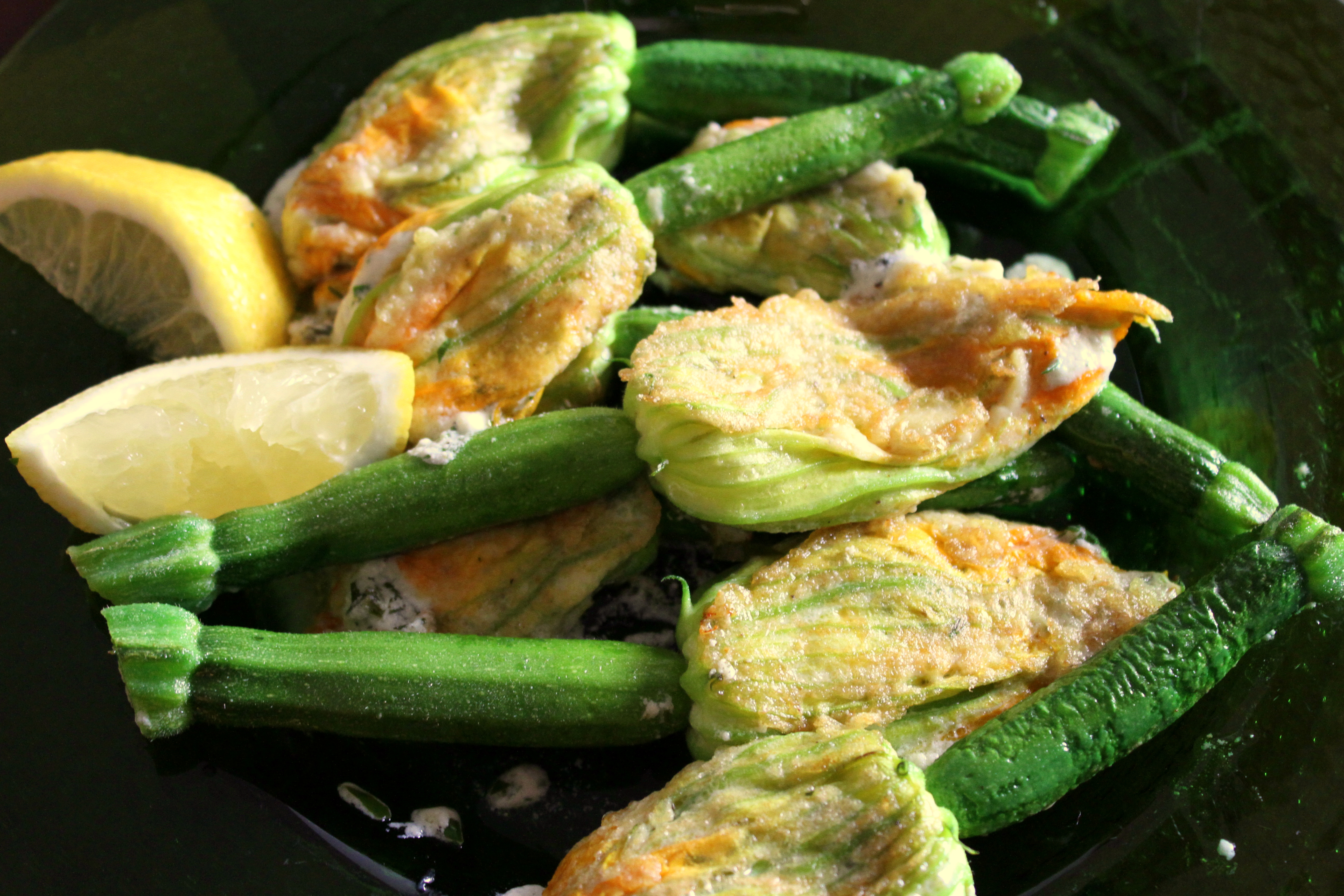
Courgettes are one of my favourite vegetables (and I should say that they are always the French courgettes to me, rather than zucchini, the Italian name for the same vegetable).  I love their mild flavour and creamy-yet-crunchy texture.  I eat them roasted, char-grilled, stewed in ratatouille, and sauteed with plenty of garlic as a simple pasta sauce.  I had never cooked the flowers before, and wanted to find a simple recipe that showcased their fresh and delicate qualities.  Most recipes will have you battering and deep-frying the flowers (as fiori di zucchini ripieni), and while this is an undeniably delicious way to go, deep frying is one of those methods that I leave for occasional indulgence at restaurants.  Searching on the Internet I found a recipe for baked stuffed flowers that looks promising, but since baking is out of the question for me right now, I settled on a recipe for pan-fried flowers that I used as a general guide, substituting flavours that appealed to me and reflected what I had on hand.  The result was a plate of tender-crisp courgettes attached to stuffed, flavour-packed flowers that would make a special nibble to serve with pre-dinner drinks, or, in my case, a luxurious lunch for one.

Courgette Flowers stuffed with Goat Cheese and Herbs

  • Servings: 1 lunch or 8-10 amuse bouche
  • Print
Adapted from Eat Out

8-10 fresh courgette flowers with tiny courgettes attached (these are female flowers as male flowers do not have a courgette attached.  Male flowers are just as tasty, but lack the cute-factor of the attached baby vegetable)
1 cup fresh goat cheese (or substitute ricotta or labneh, or for a richer version, try a very mild and creamy feta or mascarpone cheese)
3-4 Tbsp finely chopped fresh herbs (I used dill, parsley and a little purple basil)
1 tsp finely grated lemon zest
2 Tbsp finely grated parmesan
1 Tbsp olive oil
Salt and pepper
1 egg, beaten
1 tsp cornflour
Squeeze of lemon, to serve

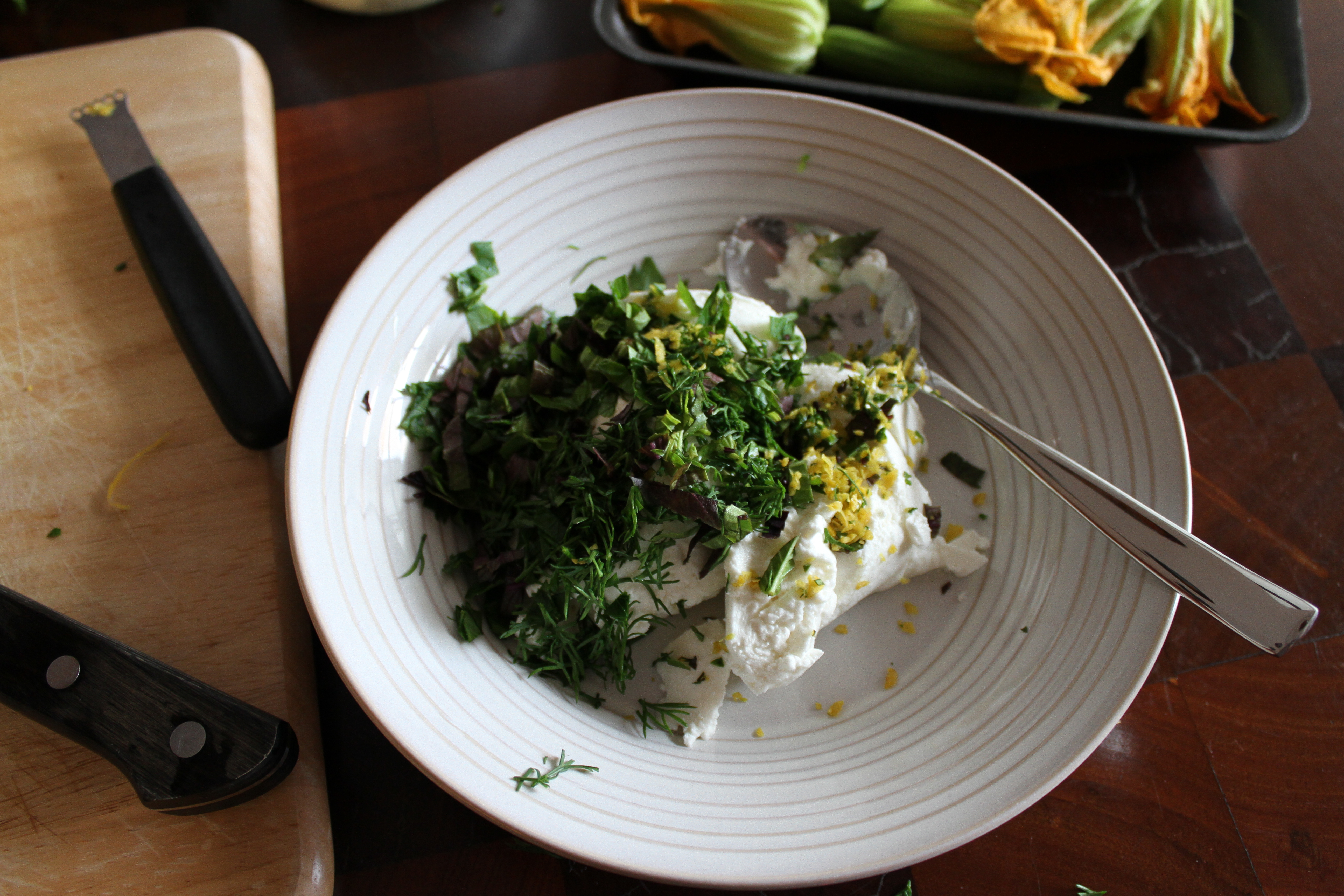
Place whatever cheese you are using into a bowl, add the herbs, lemon zest, parmesan and olive oil and mix together.  Season with a hefty pinch of salt and a few grinds of pepper.  Taste, and add further salt, herbs, lemon and/or parmesan until you have achieved a satisfyingly punchy flavour.  Set aside while you prepare the flowers.
IMG_0368

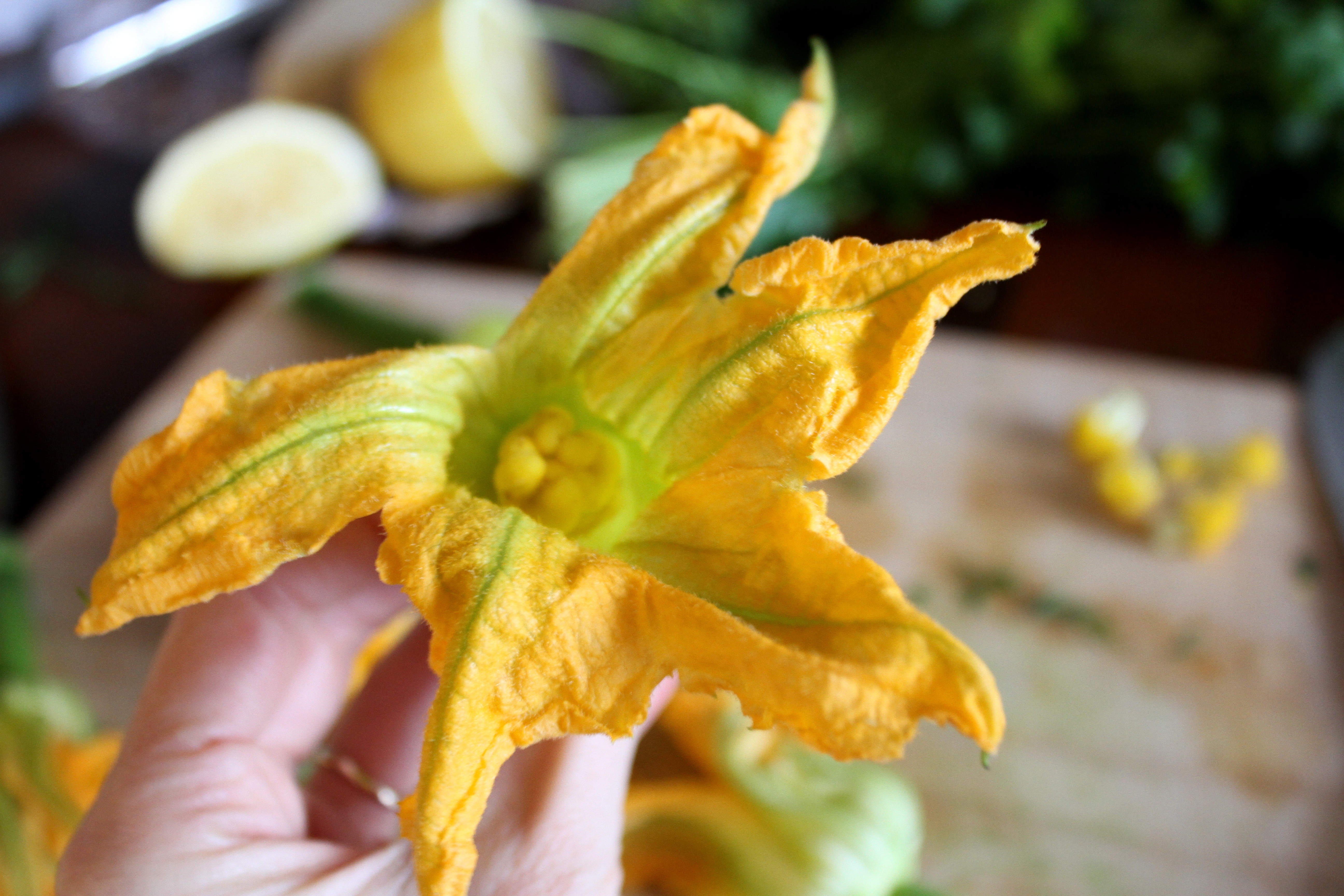
Check that the flowers are clean, and if dirty, wipe carefully with a damp cloth taking care not to damage the flowers or get too much water on them.  Taking one flower, gently prise open the petals to reveal the bulbous stigma at the base.  Remove the stigma by pinching it off with your fingernails or cutting with a paring knife (the stigma isn’t inedible, but simply has a slightly bitter flavour and is best removed).  This small operation also gives you the opportunity to ensure that the flower is free of bugs within.  Then, using a teaspoon, gently deposit about two rounded teaspoonfuls of the cheese mixture into the centre of the flower.  You can also use a piping bag to fill the flowers.  Give the petals a little twist at the top to encase the mixture, and then repeat until each flower is stuffed and ready to be fried.
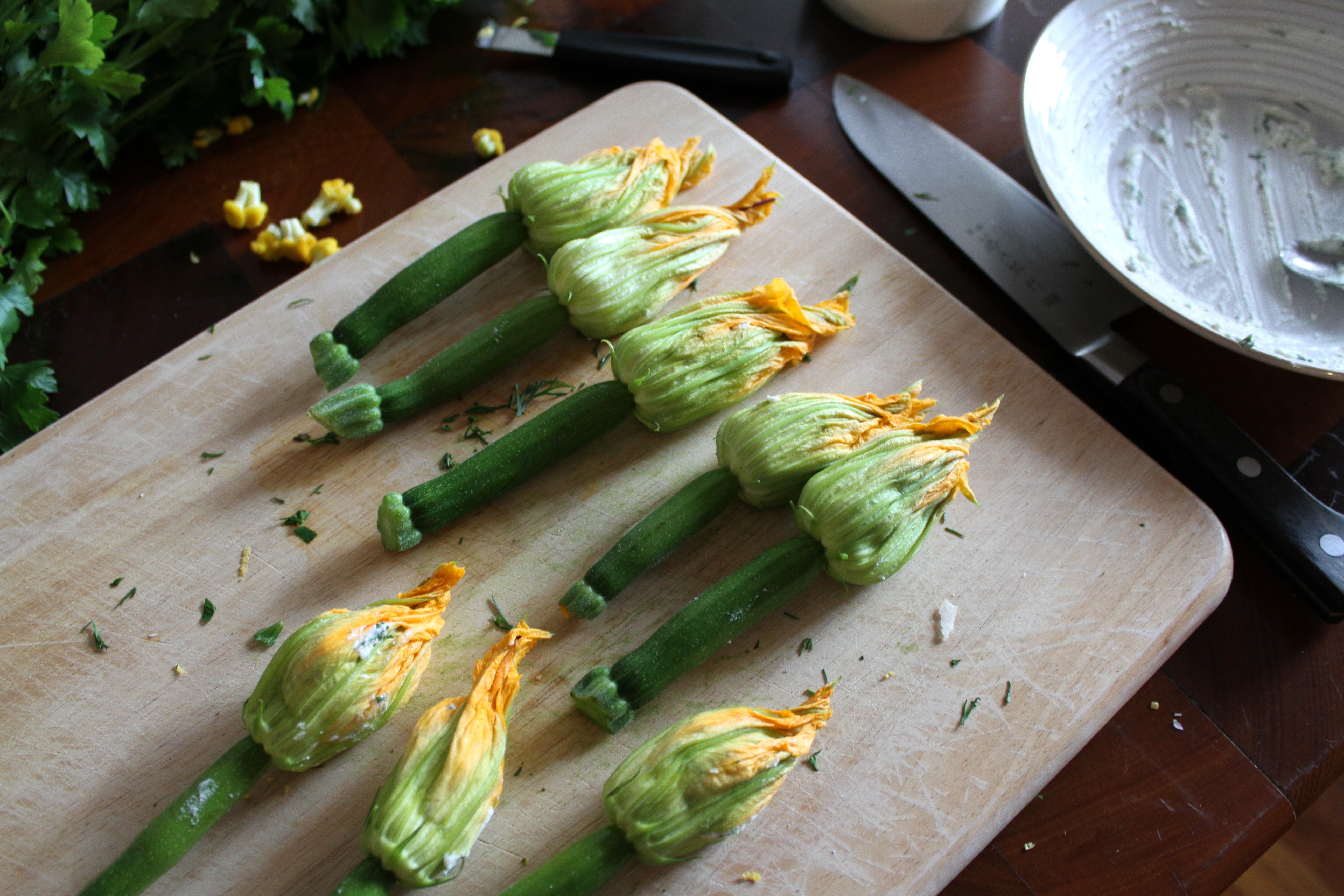
IMG_0373IMG_0377
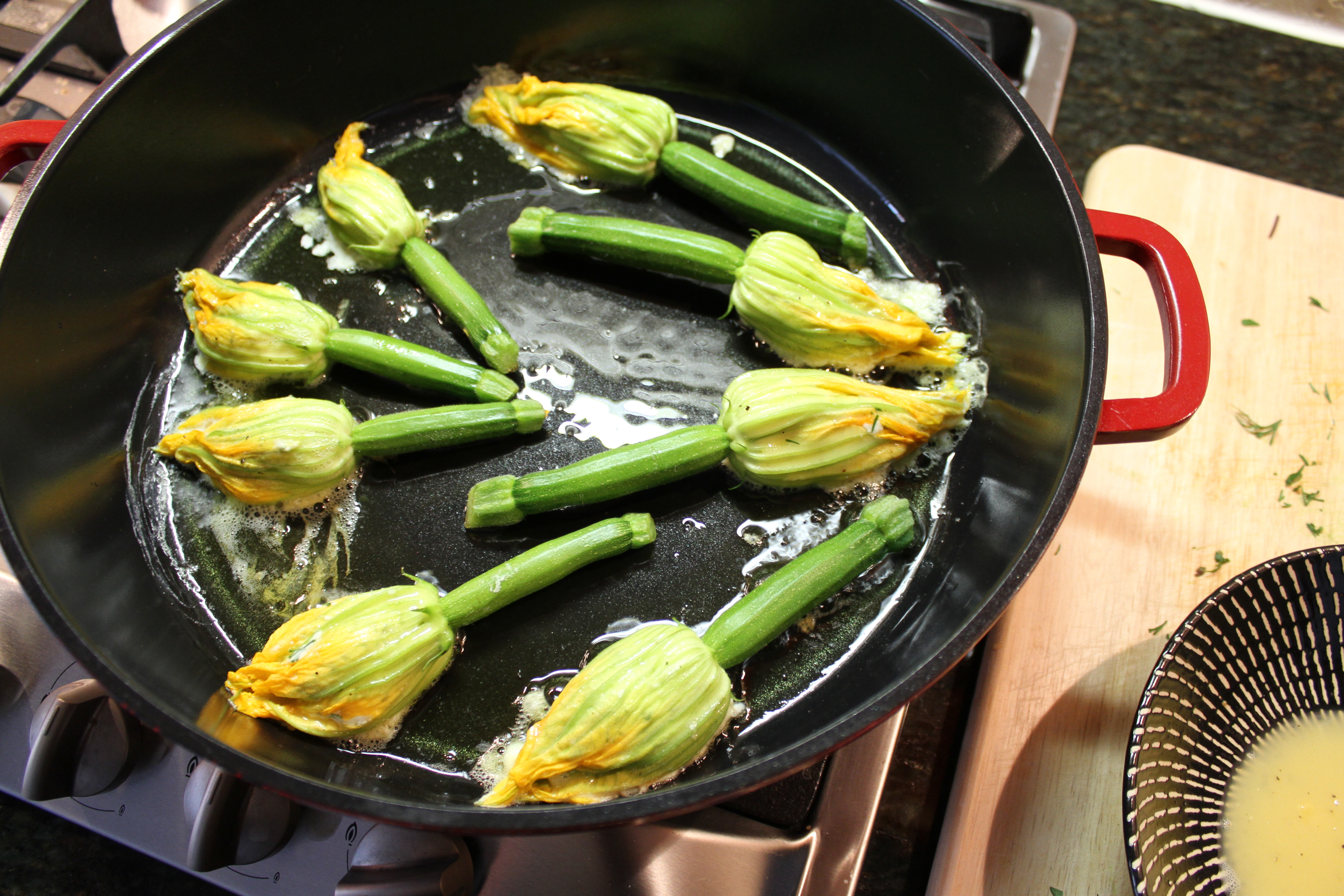
Place a heavy-bottomed frying pan over medium heat and add several tablespoons of olive oil until the bottom is coated with oil.  Break the egg into a small bowl and beat with the cornflower and a pinch of salt.  Once the pan has heated, quickly coat each flower with egg and place in the hot pan.  Fry until lightly golden and then flip over onto the second side.  Some of the cheese mixture will ooze out during this process.

Don’t worry if the baby courgettes receive minimal contact with the pan: they are already so tender that they require little more than heating through (however, if you would like to cook them more thoroughly, consider placing a single vertical cut along the length of the vegetable, taking care not to cut too close to the base of the flower).

Once the flower is lightly fried on both sides, remove to a plate, spritz with lemon and eat immediately.
IMG_0379IMG_0391

Filed under: Eat
comments 10

Small things (7D)

I have a brand new camera: a simply wonderful Canon EOS 7D!  For nearly eight years I loved my Canon 400D, even though I only ever had the standard kit lens.  The 400D was a great entry-level prosumer camera for me, and  I resisted an upgrade for a long time, wanting to feel like I had exhausted its potential before trading up.  Last Christmas I decided I had waited long enough and started to do some research into what was available and would achieve the most bang for buck.  Keen to stay within the Canon range, I quickly narrowed the pool to the 7D, which delivers impressive functionality with a very competitive price (significantly lower than its initial price at release in 2009).  But it was still a serious investment, and when we bought our apartment in late January I decided that a new camera would have to wait.  Imagine my surprise when I came home one day in April to find that Colin had bought it for me.  With the whole world as my witness, Collie, you’re the BEST 🙂

I am lucky to have a 50mm macro lens and a zoom lens, but so far all I’ve used is the standard 18-55mm kit lens.  I’m not exactly sure why, but I move pretty slowly with new toys and am taking time to get to know this camera.  Thus far there is sufficient joy to be found in the lush, vibrant colours, and the soft yet highly detailed images that emerge with minimal input from me.  In this camera I definitely have room to grow, but for a start, below are seven objects photographed in and around home: seven small details, elevated beyond their station by the lens of one amazing camera.

Note: hover your mouse over each photo for explanatory captions.

IMG_0013
IMG_0049
IMG_0111
IMG_0147
IMG_0076
IMG_0123
IMG_0215

comments 5

Poached Pears with Thyme and Coriander

IMG_0411

I haven’t used the oven in over three months since our kitchen-paint-job-gone-wrong resulted in polyurethane spray entering its interior via the vents in the door.  Given that polyurethane produces toxic gases when heated, we have diligently left the oven well alone all this time.  The good news is that the insurance claim is finally at “negotiation phase”, although what the outcome is likely to be is still a mystery.  Considering the snail’s pace with which this entire process has taken to date, I’m picking it will easily be another two months before a settlement is finalised and we can think about installing a replacement oven.

Winter is usually a time of roasting and baking, but I’ve had to make do with the stove top and slow cooker.  My usual winter curries, soups and stove top stews have continued unabated, but I miss roast chickens and the large trays of vegetables that I used to roast and resurrect in salads and pasta over the course of several meals.  On the weekends, it’s the loss of baking that I feel most keenly.  This time last year I was reveling in baked figs, apple crumble, pear cake and apple tart.  This winter, by necessity, I’m all about poaching pears.

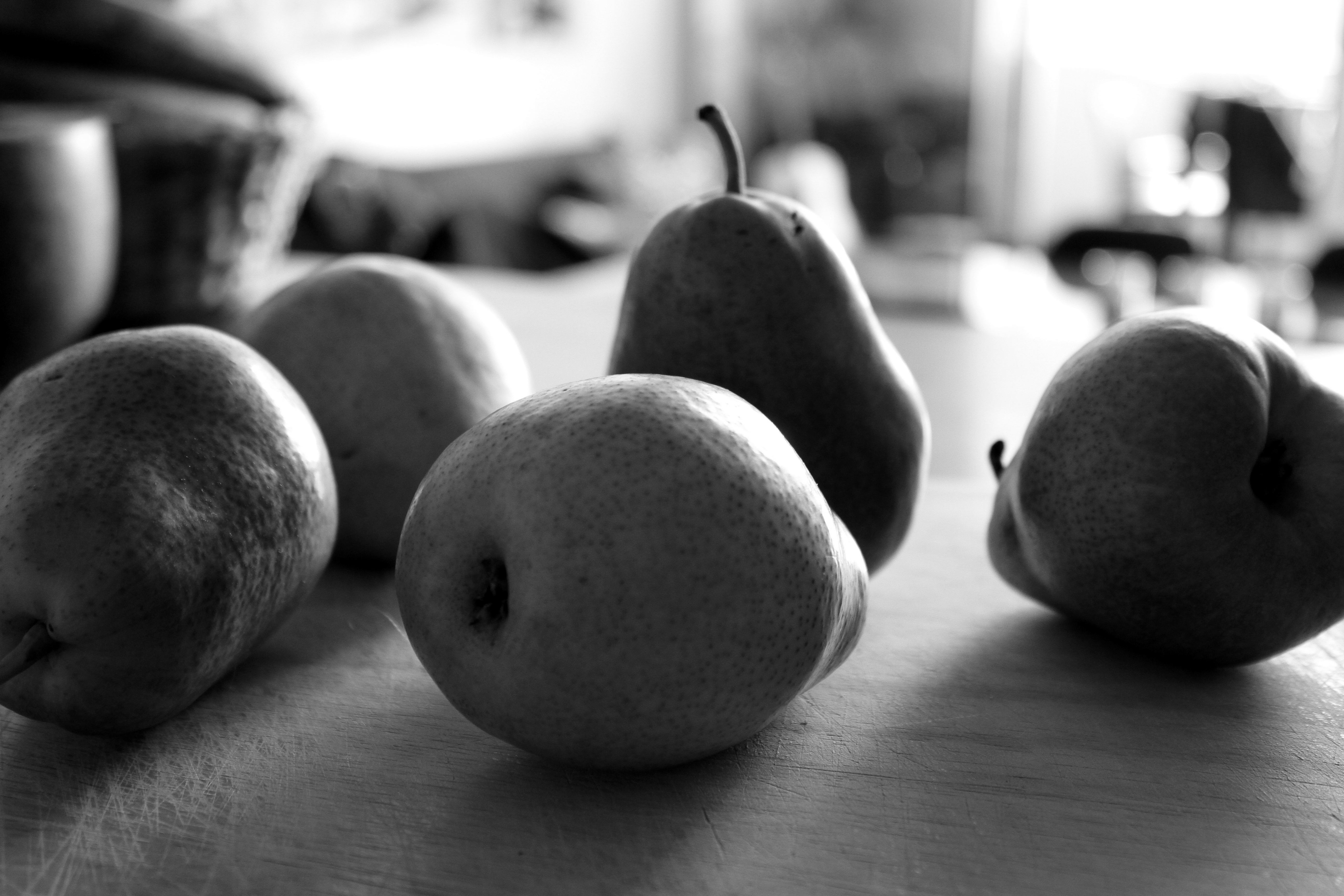
Poaching is a forgiving cooking method that is difficult to get wrong.  Throw some water and fruit in a pot, add some sugar and spices, and simmer gently until the fruit is just cooked.   I have made several variations of David Lebovitz’ spicy poached pears recently, playing around with different spice combinations, pear varieties, and sugar levels.  I’ve discovered that slightly under-ripe pears work best.  Even though they take longer to poach, very firm pears are much less likely to tilt over into mushiness or dominate the flavour profile with the over-excretion of sweet pear juice.  I also prefer the poaching syrup to be quite low in sugar, and will often tart up the liquid with a spritz of lemon juice or use a half-water-half-wine combination.  This flexibility is exactly the point: this post offers a suggestion for poached pears, not a recipe per se.

Last weekend at the market I spotted a bin of the most gorgeous, freshest thyme I’ve seen for a long time.  I rarely buy thyme as I cook with it only occasionally, usually pairing it with roast chicken or sprinkling it over meaty mushrooms before roasting them in the oven.  Although both options were unachievable in my current kitchen, I could not walk past this thyme with its dark, dense, springy leaves.  When I spotted a bin of rosy pears at a different stall, I immediately knew that I wanted to try combining the two.

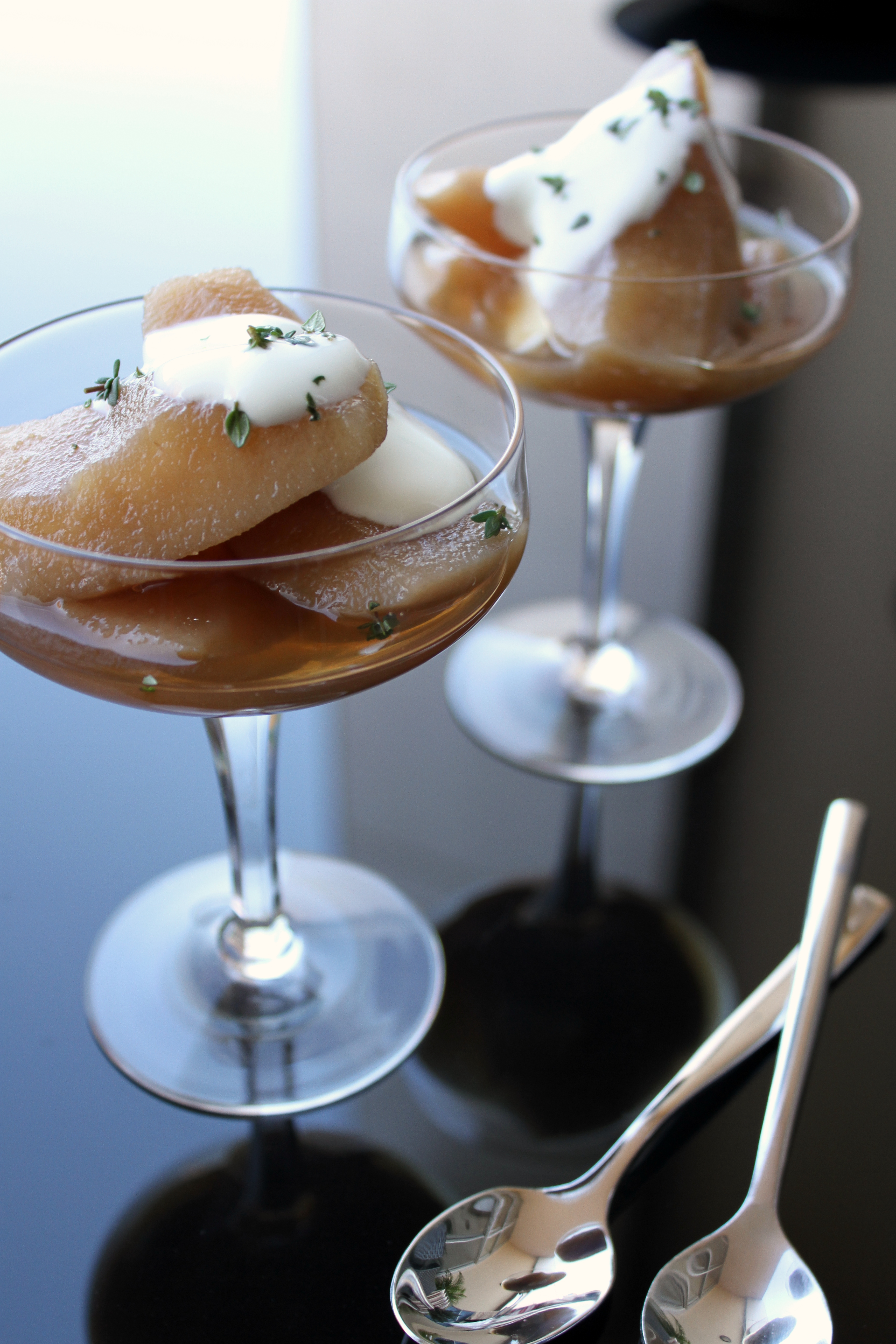
In order to emphasise the thyme flavour, I elected to reduce the amount of sugar I would usually use.  I also added black peppercorns and some whole coriander seeds to provide depth and a background spicy warmth.  The resulting dish has an interesting flavour profile that borders on savoury – the word “masculine” came to my mind as an appropriate descriptor.  It works with yoghurt or crème fraiche as a simple-yet-sophisticated dessert, but will just as easily complement slices of sharp cheddar, replacing quince paste or grapes on a cheese board.  Oven-deprivation isn’t always a bad thing if sexy pears like this are the result!

IMG_0437

Poached Pears with Thyme and Coriander

5-6 firm, slightly under-ripe pears
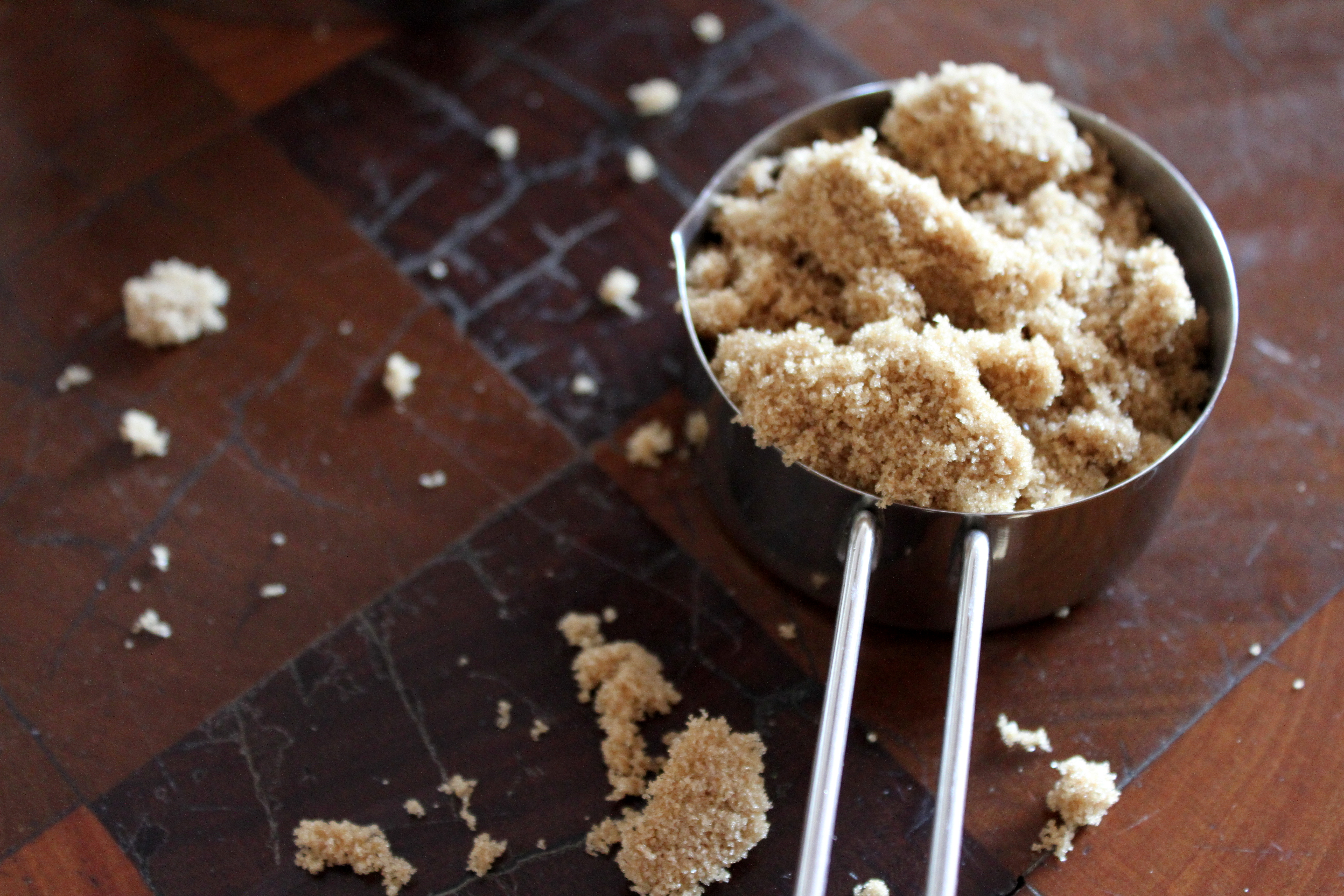
1/3 cup brown sugar (roughly measured, i.e. not packed)
1 ¼ cups water
1 ¼ cups dry white wine
2 Tbsp coriander seeds
½ tsp black peppercorns
Fresh thyme and yoghurt or crème fraiche, to serve

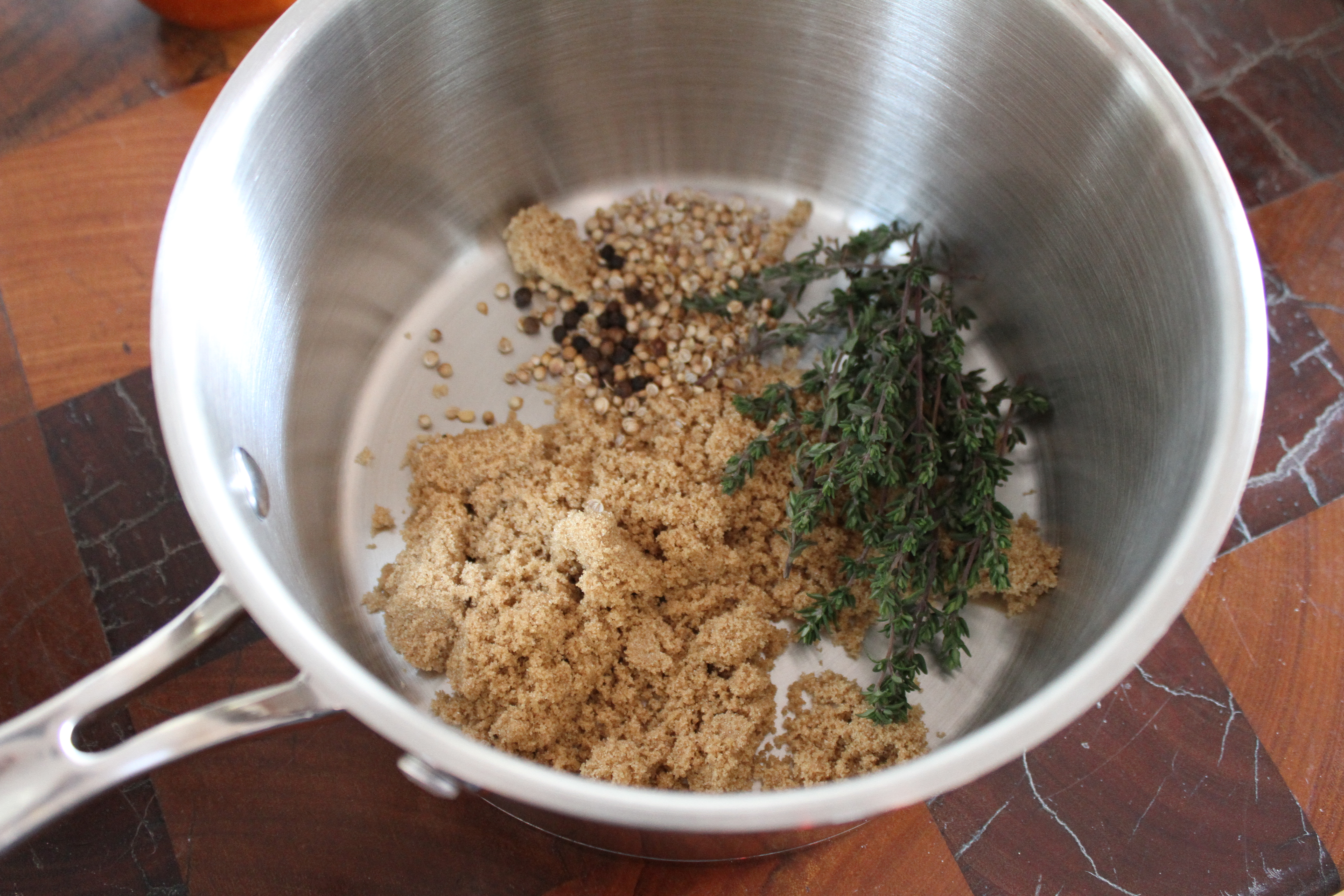
Place the brown sugar, wine and water in a medium saucepan along with the peppercorns. Lightly crack the coriander seeds in a mortar and pestle and add these as well.  Bring the pot to a boil to dissolve the sugar.

IMG_0414 IMG_0418

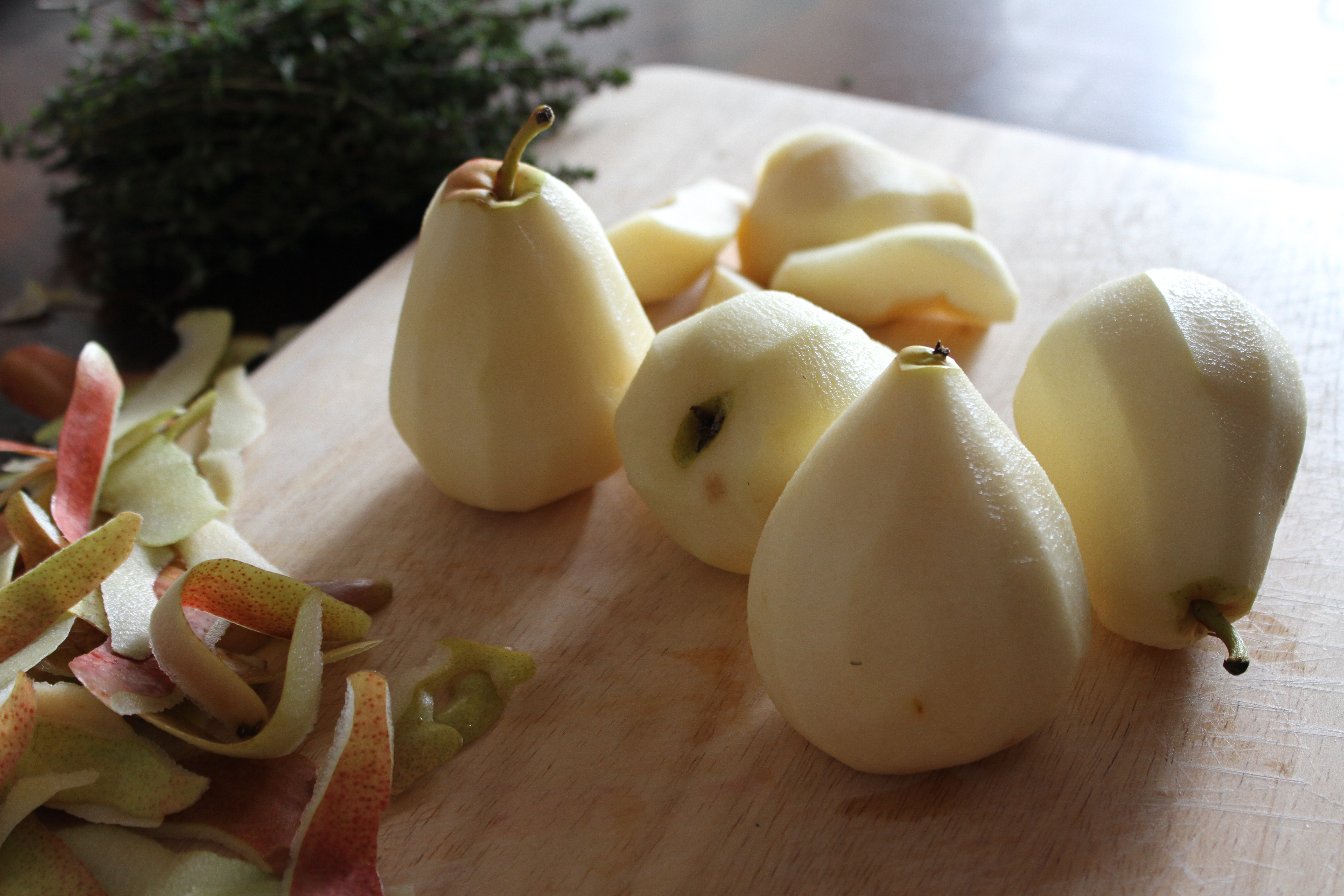
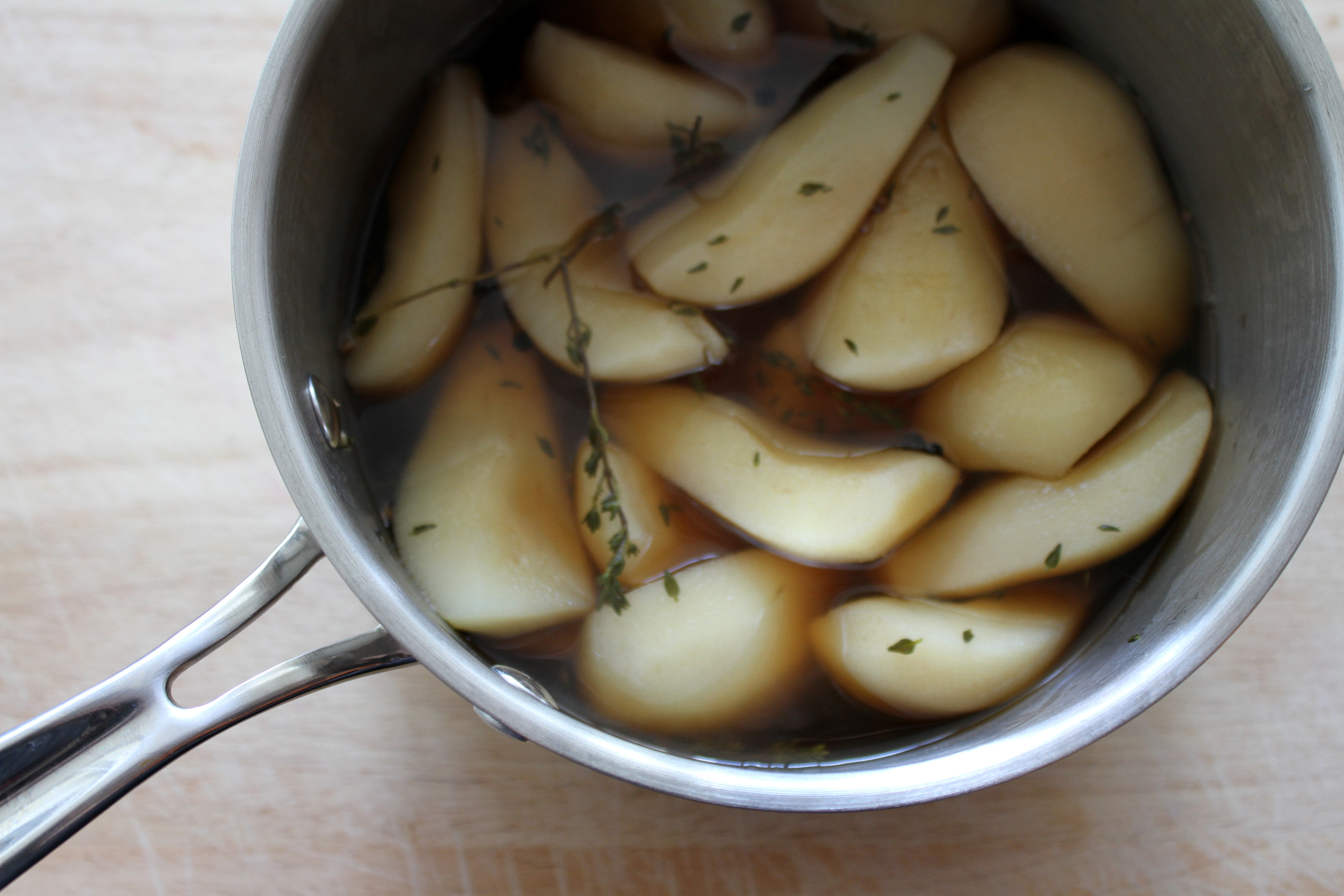
While the liquid is heating, peel the pears, quarter and remove the cores.  Add the pears to the boiling water and top up with a little extra water if needed.  Add several generous sprigs of thyme to the pot.  Once the water has come back to the boil, turn the heat down and gently simmer the pears until they are al dente (tender but still retaining a little bite).

IMG_0426
Remove from the heat but leave the pears to cool in the pot.  Taste the poaching liquid to check the flavours: if necessary, add more fresh thyme to infuse as the liquid cools, a spritz of lemon to adjust the acidity, or a little more sugar if you want to increase the sweetness.  Serve the pears warm or chilled with a spoonful or two of the poaching liquid, topped with yoghurt or crème fraiche and sprinkled with fresh thyme.

IMG_0427

Filed under: Eat
comments 8

Meat and I

IMG_0235
A quick glance at my recipe list easily gives the impression that I am a vegetarian, but then people sometimes take a quick glance at me and assume I’m vegetarian (am I that pale?).  I do cook a lot of vegetarian food, but I also eat meat on a regular basis.  It wasn’t always this way though.  My history with meat is somewhat checkered; still is, a little, otherwise I wouldn’t feel compelled to give a back story to the first meaty recipe to appear on this blog.

I was raised carnivorous, and really there are few other ways to be growing up on a farm in rural New Zealand.  Our pet lambs always landed up on the table eventually, with our parents informing us partway through the meal that we were eating Tommy or Rambo or Jack.  I can’t ever recall feeling upset about this, possibly because by the time they were large enough to be butchered, our cute little lambs had long grown up, reintegrated with the flock and been forgotten by us children.  We were protected from the slaughter itself, although one exception was the time that Mum told my sister and I to stay in the backyard because Poppa was killing chickens.  Well of course we couldn’t resist the temptation to climb to the very top of our jungle gym so we could see what was happening over the fence.

IMG_0199

My favourite childhood meal was fat homemade potato chips, fried eggs, crumbed weiner schnitzel and Mum’s amazing homemade tomato sauce.  I can still taste this meal.  I would eat it right this very second if I could.  It sounds indulgent – and it was – but we only ate it occasionally as a weekend treat.  As a woman who came of age during the hippie era, Mum was an old hand at sprouting mung beans.  We always had brown rice and brown bread, and breakfast was porridge or Weetbix, with Cocoa Pops only an occasional treat during school holidays.  We lived more than two hours drive from the nearest McDonald’s and half an hour from the nearest supermarket.  Almost everything we ate was homemade.

I never thought twice about meat growing up.  Until I was 14, it was just food that we ate almost every night.  My first boyfriend changed all that.  He was from the UK and his family had some distinctly different ideas about food and food practices.  At his place, a jug of water and glasses were an essential addition to the dinner table.  In most other homes I knew, if you wanted a drink of water during dinner you excused yourself from the table to get it from the tap.  Anyway, this boyfriend had an acne-problem and he was quite phobic about fat.  One day he joined my family for a BBQ dinner and piled a mountain of salad on his plate, adding only a small piece of meat.  I must have asked him about it, because he went on to talk about the fat content of meat and the virtues of salad, subtly disapproving of the proportions on my plate.  At the time I was too intimidated to ask him why he had covered his entire salad with a thick layer of grated cheese.

IMG_0200

Although that boyfriend didn’t last long, from that day onwards I began to reduce the amount of meat I consumed.  Despite these dubious origins, I did begin to perceive that a heavy meat meal felt less comfortable in my stomach than a meal dominated by vegetables. Two or three years later I read my mother’s old copy of Fit for Life, and subsequently developed an interest in nutrition, naturopathy and organics.  I began to eat vegetarian at times, and was interested to see how this created some ripples at home, particularly with my grandmother who strongly believed that eating meat was sanctioned in the Bible and thus a kind of holy obligation.  Food, health, politics and religion became inextricably intertwined.  Eating became more exciting, what I would later come to think of as an ideological act.

At 18, I moved to the city to attend university.  The quality of my diet plummeted as I joined my new friends in the novelty of pizza deliveries, fast food and midnight meals at Denny’s.  At 20, I reconnected with my earlier focus and decided to radically overhaul my diet.  Sandra Cabot’s Liver Cleansing Diet was all the rage, and I embarked on a strict vegan diet.  I felt good physically, but the deprivation got to me after a while.  For the next few years I oscillated between periods of being ultra-healthy and longer periods of completely letting go.  My ‘healthy’ periods were dominated by zealous vegetarianism and new foods like tempeh and seaweed.  I wasn’t a very good cook back then, and much of what I ate was bland and unsatisfying.  It’s no wonder that I always broke and swung completely the other way.  Although I still identified as vegetarian, the highly processed hamburgers at Burger King were my frequent and guilty addiction.  It was during these times that I lost my ability to enjoy the taste of fruit and would forget about the vegetables rotting out of sight in the fridge.  This would continue until a feeling of revulsion would engender a new wave of reform.

IMG_0203

By my mid- to late 20’s I was beginning to relax a little.  Colin and I started to eat out at better quality restaurants and I grew to love simple Mediterranean meals like pasta with roasted vegetables, feta and olives in salad, and caramelised onion tart.  I realised that I had been sacrificing flavour for ‘health’ and that it was possible for food to taste wonderful and be good for you.  With newly inspired tastebuds, I grew more adventurous and sought to try all sorts of new foods.  It was probably inevitable that one night at a restaurant I asked Colin if I could try a bite of his steak.  That first mouthful was strangely tasteless and disconcertingly rubbery, but there came a time when Colin ordered a medium-rare eye fillet steak…and well, it was deliciously soft and juicy.  Before long I began to actively identify as “meat-curious”; a tongue-in-(beef)cheek construction that referenced an increasing delight in food.

While there have been further experiments, these days I’m open to almost any food.  There has been much discussion in the blogosphere lately on intuitive eating, and while I now have an aversion to following any specific approach to food, I do feel some affinity with this philosophy.  I eat meat when I feel like it; generally about twice a week, maybe more in winter, but I can easily go for two or three weeks without it.  I’m very aware these days of how food makes me feel physically.  Lots of vegetables and fruit make my stomach feel content, while too much meat, fried food and sugar makes me heavy and irritated. Like everyone, I have periods when I don’t eat so well because life gets busy.  Episodes of indigestion tell me when I need to stop eating crackers and cheese for dinner.  I’ve found that the quickest way to restore a sense of balance is to spend a week or two eating according to my Ayurvedic body type (Vatta), emphasising warm and soft foods like brown rice, quinoa porridge and lentil soup.

IMG_0213

One of my favourite ways to eat meat is in slow-cooked winter casseroles.  I love how this process turns tough cuts into meltingly tender morsels – even now, meat hinges on texture for me and any hint of toughness or gristle switches me right off.  The recipe below is loosely based on a recipe for Beef Bourguignon although I have changed the flavours and quantities considerably.  I cooked it all day in a slow cooker, but it is also possible to bake it for 2-3 hours in a moderate oven later in the day.

Asian-spiced Beef Casserole

Adapted from delicious June 2013 issue

1-2kg stewing beef, such as blade, chuck or gravy beef
Whole spices, including 1-2 cinnamon sticks, 2-3 star anise, a thumb sized piece of fresh ginger (peeled and sliced), 1-2 chillies
2 cups red wine
3 slices of bacon, diced
2-3 garlic cloves, crushed
Selection of fresh vegetables, such as carrots, red onion, red capsicum, baby turnips
Beef or chicken stock
Soy sauce, to taste

Begin this recipe the night before.  Trim any fat off the meat and cut into 3cm chunks.  Place in a large bowl along with the spices and just cover with red wine.  Cover the bowl and refrigerate overnight.

IMG_0210

The next morning, remove the meat from the wine (reserve the liquid and spices), pat dry the meat then fry it in batches until lightly browned.  Place the browned meat in the slow-cooker bowl.  Quickly fry off the diced bacon and garlic in the pan you used to fry the meat, then give the carrots and onions a few minutes in the pan to take on a little extra flavour.  Place the bacon and vegetables in the bowl with the meat, and add other vegetables, such as whole baby turnips and strips of red capsicum.  Pour over the reserved wine and spices.  De-glaze the frying pan with stock, and add to the bowl, topping up with extra stock until the liquid just reaches the top of the meat.  Add a good dash of soy sauce, pop the lid on and cook on slow until dinnertime.

IMG_0234

Filed under: Eat